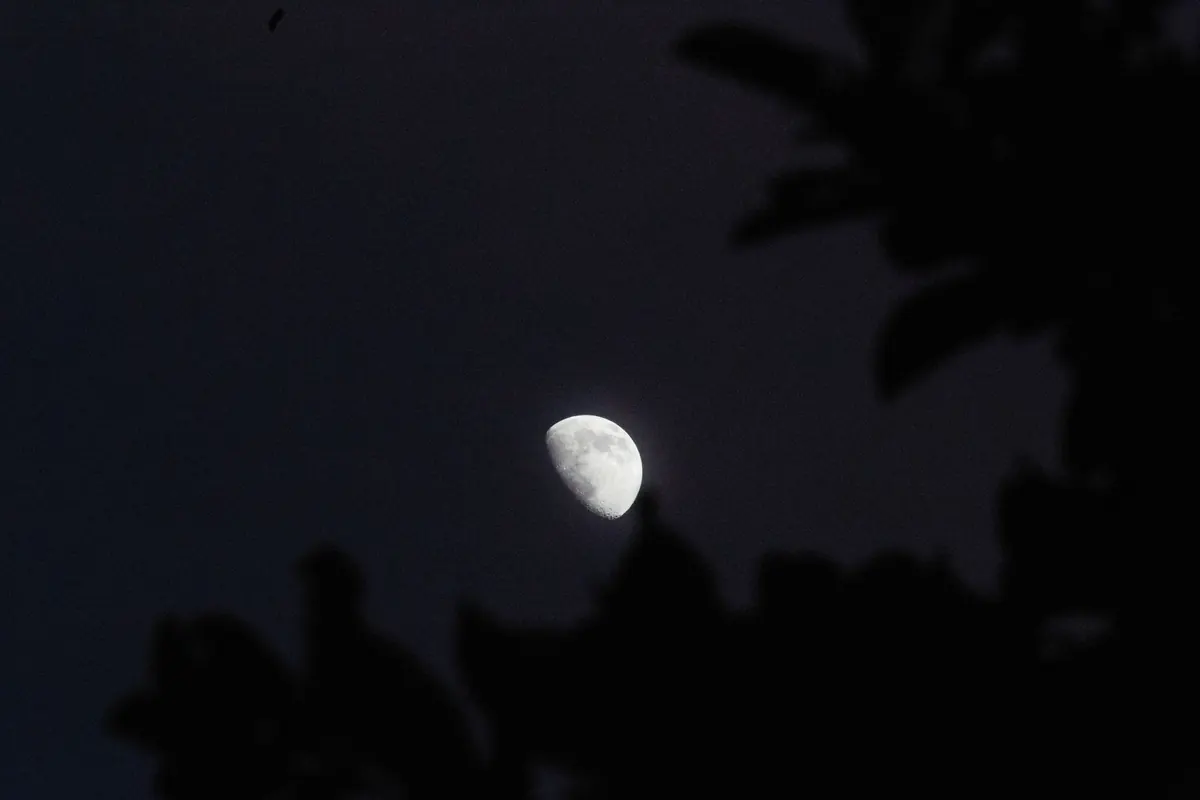
Two evenings in a row, same time, same window. The first night the Moon hangs low in the west as a thin bright sliver. The next night that patch of sky is empty, and if you keep looking at the same hour for another week you may not catch it at all. Nothing has gone wrong, and nothing about it is random. The Moon keeps a schedule, and that schedule is written in its phase. Learn to read the connection and you can step outside on any clear evening and know, within a quarter of an hour or so, whether the Moon will be up — and roughly where to look.
The phase and the hour come from the same angle
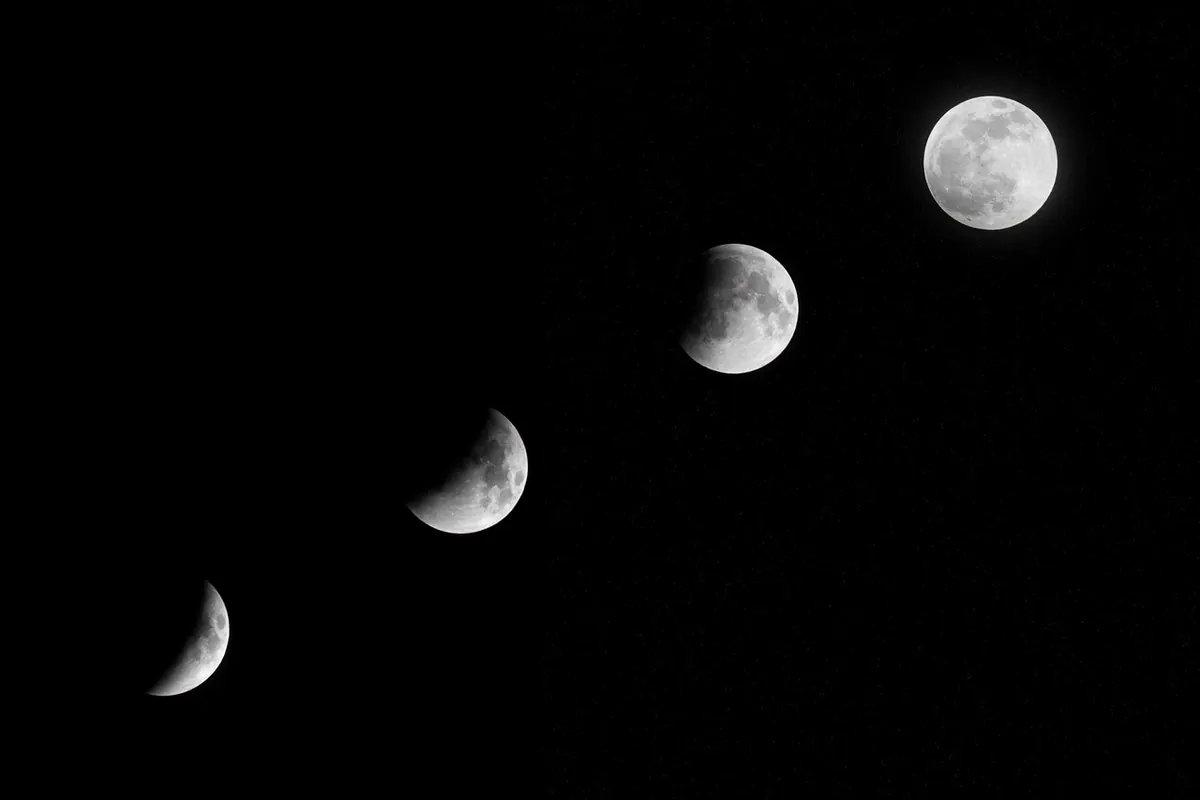
The Moon makes no light of its own. Half of it is always sunlit; the half we see changes because our viewing angle changes as the Moon travels around us. When the Moon sits roughly between Earth and Sun, the lit half faces away and we get a new Moon. When Earth sits between the two, the lit half faces us and we get a full Moon. Halfway through that cycle we see exactly half the disc lit — first quarter or last quarter, depending on which direction the Moon is heading.
That same angle also fixes where the Moon appears relative to the Sun in our sky. It cannot do otherwise. A new Moon is near the Sun, so it is up during the day and down at night. A full Moon is opposite the Sun, so it rises as the Sun sets and sets as the Sun rises. The rise time is not a separate fact to memorise; it is the phase geometry seen from a different side.
Why moonrise slides about fifty minutes later each night
Here is the mechanism in plain terms. Earth spins once every 24 hours. The Moon, meanwhile, is moving eastward along its orbit, covering about 13 degrees per day against the stars — a little less against the Sun, because Earth is moving too. That daily eastward shift means our planet has to turn a bit further before the Moon is back in the same place in the sky.
How much further? About 12 degrees of rotation, which is close to 50 minutes of time. A full cycle of phases takes roughly 29.5 days, and 24 hours divided by 29.5 gives about 49 minutes. That is the whole trick.
So if the Moon rises at 7:00 this evening, expect it near 7:50 tomorrow and around 8:40 the night after. After a week the delay has accumulated to five or six hours, which is why the Moon that was a fixture of your early evening a week ago is now arriving after you have gone to bed. Over a month the delay sweeps all the way around the clock, and the phase sweeps with it.
What each phase means for your evening
These are rules of thumb, not clock times. Think in terms of sunrise and sunset rather than digits on a phone, because the Sun's own schedule shifts through the year and daylight saving moves the numbers again. For a mid-latitude observer:
- New Moon — rises with the Sun and sets with the Sun. Effectively invisible, lost in the glare, except during a solar eclipse.
- Waxing crescent — rises a couple of hours after sunrise and sets in the evening, shortly after the Sun. This is your best crescent view: look west-low about half an hour after sunset.
- First quarter — rises around midday, stands highest at sunset, sets around midnight. A convenient Moon for evening observing.
- Waxing gibbous — rises in the afternoon, is already up at dusk, and sets in the small hours.
- Full Moon — rises at sunset, is highest near midnight, sets at sunrise. It owns the whole night.
- Waning gibbous — rises two or three hours after sunset and is still up in the morning.
- Last quarter — rises around midnight, stands highest at sunrise, sets around midday.
- Waning crescent — rises in the hours before dawn and sets in the afternoon. Look east before sunrise.
Notice the pattern: each phase is tied to a quarter of the day. That relationship holds everywhere on Earth, in both hemispheres, even though the Moon's orientation in the sky does not.
Fifty minutes is only an average
The nightly delay is not a fixed quantity. Depending on your latitude and the time of year, it can run from about 20 minutes to well over an hour. The reason is the angle the Moon's path makes with your horizon. When that path meets the horizon steeply, the Moon clears it quickly and the delay is short. When the path runs shallow, nearly parallel to the ground, the Moon has to travel a long way sideways before it lifts above the horizon, and the delay stretches out.
The famous case is the Harvest Moon, the full Moon nearest the autumn equinox. At mid-northern latitudes the Moon's path is then so shallow that successive moonrises come only about 25 to 30 minutes apart for several evenings in a row. Before electric light, that run of bright early evenings arriving almost on schedule was a genuine gift at harvest time, and the name stuck.
Latitude matters too. Near the equator the Moon climbs and sets briskly and the delays stay modest. Farther north or south the swings get wider, and inside the polar circles the Moon can stay above the horizon or below it for days at a stretch. The Moon's orbit is also tilted about five degrees to the plane of Earth's orbit, which adds a slow wobble on top of everything else.
Where it rises, and how high it climbs
The Moon rises in the east and sets in the west, but that is a coarse description. The exact compass point drifts night by night, swinging between its northern and southern extremes over the course of a month and a year combined. If you have a landmark on your eastern horizon — a chimney, a particular tree — you can watch the Moon come up behind it at the same phase each month and see the shift for yourself.
Height is where the phase pays off again. Because a full Moon sits opposite the Sun, it occupies the part of the sky the Sun will occupy six months from now. In the northern hemisphere, a full Moon in winter therefore climbs high and stays up for a long stretch, while a full Moon in summer stays low and brief. In the southern hemisphere that is reversed. The same logic applies to any phase, which is why the waxing crescent of spring sits differently from the waxing crescent of autumn.
One thing to file away: the Moon looks enormous when it sits just above the horizon. It is not closer, and no lens effect is involved. It is a persistent trick of perception, and knowing that does not make it any less enjoyable to watch.
Reading the Moon without a chart
You can estimate the phase and the hour from the shape alone. A Moon lit on its western side is waxing — it is a few days past new, and the lit edge points toward the Sun, which has either just set or is about to. If it is low in the west after dusk and lit on the west, it is young, and it will follow the Sun down within an hour or two. A Moon lit on its eastern side is waning and has already passed full; it will be up in the morning sky.
That lit edge, the terminator, is also the most interesting part of the disc through binoculars or a small telescope. Shadows there are long, and craters along it look like a ragged mountain range. A full Moon, however bright and impressive, is flat and washed out by comparison.
And do not overlook the daylight Moon. First quarter is often visible in the afternoon, and last quarter in the morning, pale against a blue sky. Once you know which quarter you are in, you know where to find it.
A simple routine for the next clear night
- Check the phase before you go out. A calendar or any planetarium app will tell you the phase and the predicted moonrise for your location.
- Go out at sunset and look east for a full or near-full Moon, or west for a crescent.
- Note the time and the Moon's position relative to a fixed object — a rooftop, a tree, a streetlight.
- Go back to the same spot at the same clock time the next night. The Moon will have moved east and up, or east and out of view.
- Predict the next night's position before you check. Two weeks of this and the arithmetic stops being arithmetic and becomes instinct.
Keep a few notes: date, phase, rise time, where it appeared. After a month you will have your own small almanac, and you will find yourself glancing at a crescent in the dusk and knowing, without reaching for a phone, that it will be gone within the hour.
Photo: Alexey Demidov / Pexels